Chickens in the Desert: Hatching and Brooding Chicks Naturally
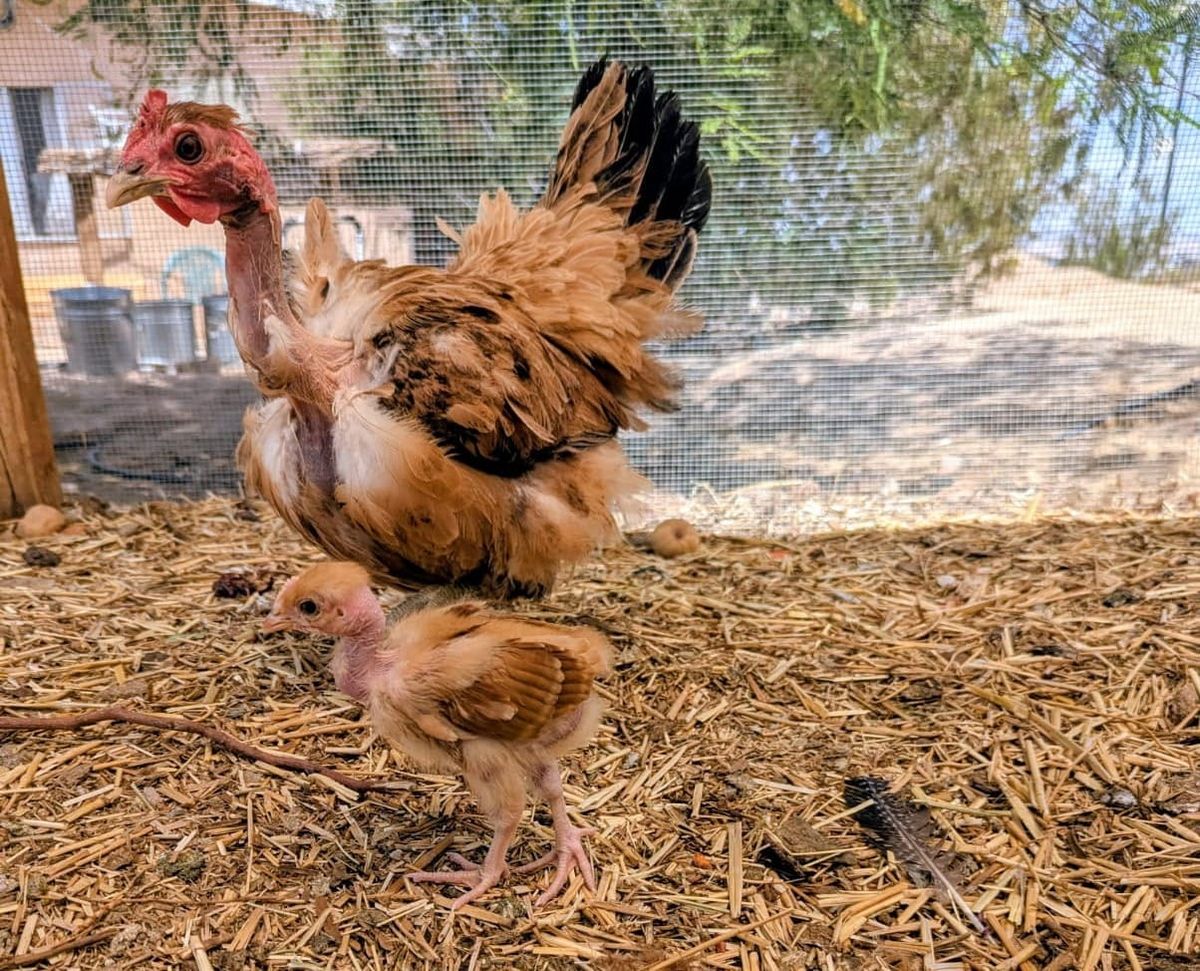
Chickens are a natural first choice for livestock on a farm. They're relatively self-sufficient, act as excellent pest control for gardens or orchards when correctly managed, are generally hardy against various environmental factors, and they're small enough to handle even if you're completely new to animals. Obviously, we all love chickens. The barrier to entry is low, they're cost efficient, and they provide yield even to those who aren't yet ready to process their own meat in the form of nutritious eggs.
Most who raise chickens get their first flock in the mail, though some get got by the feed store stock tank selection. If you've done the former, you know – it's so exciting the first time! You wait and wait for the post office to call, and when you finally go pick up your box it wiggles and peeps with the fluffy little darlings inside. You take them home, put them in their little brooder, and you put down food and clean water and after just a few weeks they stop being tiny balls of fluff and start feathering out, relatively soon to be a mature flock laying eggs in your backyard. After a time, though, this process loses its charm. The big hatcheries (and yes, that's where the feed stores are getting their stock, too) aren't engaged in the kinds of practices most of us want to support, and we're still reliant on the mail order each and every time we need to replace layers or get our meat birds for the season. Also, if we wish to curate the genetics of the stock on our farm – increase heat hardiness, disease resistance, foraging efficiency, maternal instincts and that kind of thing – we're just out of luck with hatchery stock.
But obviously there's a different way to do things. I mean, we all know that not all baby animals come in the mail or from a store, right? Chickens are actually very capable of making more chickens. And while their ancestor the jungle fowl is completely adept at doing this on its own in the wild, our birds probably need just a tiny bit of assistance from us to succeed in the controlled conditions of a farm. Lucky for us, unlike mammals, who must invest a significant amount of energy into breeding and whose breeding must therefore be managed more strictly on a farm, chickens already lay eggs frequently, so if you have a rooster they're very likely already fertilized and ready to incubate. Our hens also come pre-programmed, if you will, with a set of instinctive instructions for how to incubate their own eggs and keep their chicks alive until they're ready to fend for themselves. All they need from us is some help making sure that in the confines of a coop they can:
- Continue sitting on the same clutch of eggs without interference from the other hens (which frequently leads to broken eggs)
- Access food, water, and a dust bath
- Not get confused by the eggs being laid by other hens
- Not block access to the nest boxes the other hens are accustomed to using
- Provide a safe space to brood her chicks without dealing with aggression or competition from the other hens until the chicks can manage
We'll get to the concept of using a brood box in a second, and the way we implement this here at the Ranch to avoid some of the common pitfalls we've found with the common brood box implementations, but first, we need to talk about getting a hen to go broody in the first place.
First: the hen
In our quest to breed hens that produce lots and lots of eggs, most breeders have bred out the instinct to go broody. Broodiness refers to a hen's desire to sit on eggs until they hatch. In the wild, jungle fowl (and a few other types of birds that humans have domesticated, like ducks and guineas) lay an egg a day during their peak reproductive season, which is often Spring as they days lengthen, and when they've accumulated a good amount their body is triggered to sit. Usually, a hen would accumulate these eggs somewhere safe and hidden from predators, where she will also be safe while relatively stationary for the duration of the incubation period. For a chicken, this period is very frequently exactly 21 days or very close to it[1], and the magic number of eggs that triggers her body to sit is usually between 10-12[2]. So why would farmers not want their hens hatching their own chicks if it's such a boon to cost efficiency and ethics? Well, in the era of intensive, large-scale industrial agriculture, egg farms want to focus on eggs, and meat farms on meat. Losing three weeks a year of egg yield from a hen is consequential in their book, because that's profit lost. They hold back eggs and incubate their own, because they've already invested in enormous incubators[3] and they're raising battery caged chickens anyway, so "extra" infrastructure for raising chickens to laying age is really nonexistent, and they reap no benefit from more adept birds – or happier birds, for that matter.
But we care about the ethics, and the cost of replacements, and creating our own genetic lines that are especially suited to thrive in our specific environment, and we probably care a lot less about one hen not laying for three weeks so long as we have enough other hens going to still provide our kitchen with what it needs. Yet, most of us are probably still going to be impacted by the ethics of large-scale farming, because we may find ourselves with hens that never go broody.
What makes a hen go broody?
There are several factors that make hens go broody. First, I've read that the lengthening of days triggers their body into an awareness that the Earth is warming and it's going to be safer to rear chicks than when snow covers all. However, this feels a bit like a European projection, since Gallus gallus, our chickens' ancestor, hails from parts of South and Southeast Asia where temperatures are unlikely to plunge and snow is mostly unheard of except in mountainous regions (where as far as I can find jungle fowl aren't found). My hunch, then, is that it has more to do with either the end of a rainy season or the birds' ability to consume more calories during longer days[4] and create an energy stockpile than some innate awareness of snow, but either way, Spring tends to be the magic time for motherhood for maternally-oriented hens.
Second, some breeds are going to retain their maternal instincts better. High-output layers like the popular Leghorns are unlikely to go broody because the instinct has been more specifically bred out in favor of consistent egg laying and peak feed efficiency. Many heritage, dual-purpose breeds are somewhat more likely, but it's variable. In Storey's Guide to Raising Chickens by Gail Damerow, the author provides a table listing some of the most common chicken breeds and their likelihood of broodiness. Still, you'll find some variation within breeds. Notably, silkies are known for their maternal skill and are often used as a single addition to a small flock specifically for brooding a yearly clutch of new chicks when the other breeds kept are less likely to do so.
Additionally, and importantly, hens are more likely to go broody when they see a collection of eggs.
So there are three key factors: lengthening days, eggs piling up, and the hen's specific genetic proclivity. Knowing these enables us to potentially trigger our hens to go broody when we want them to, or at least try to see if anyone in our flock is ready for parenthood. We can wait until late April or early May and either begin collecting eggs less frequently so that a clutch of 10-12 can accumulate or use "fake eggs" to see if anyone settles down with them. The latter might be cleverer if you're at all worried about eggs being broken or lost.
How do I know if my hen is broody?
Usually if you go collect eggs and a hen is still on the nest, they'll hop off when you come in or will run off in a flutter if you stick your hand underneath them to grab the eggs they're sitting on. A broody hen, however, will puff herself up, growl, and try to peck you. She will avoid getting off the nest, even if you're bothering her. Good! Now, the real test comes at night. If she remains on the nest overnight, she's probably pretty serious. We usually allow two full nights as a test, and if she's still there on the third morning we start to prepare to close up the brood box – and yes, we're getting to that.
In the next section, we'll walk through what to do once your hen has gone broody, and go over what to expect from this whole "brooding" thing.
If you can't get one of your existing flock members to go broody, though, don't fret. One of the easiest solutions is to purchase a single hen of a breed type that is likely to go broody, such as a silkie. You can also just keep trying different things if you're in no rush: try fake eggs, real ones, altering your timing, making your nest boxes more private or comfortable if you think there could be issues there, but I wouldn't invest too much into trying to convince birds that just might not have the instinct do mother. Also, never try to "force" a brood by locking a hen in a box with some eggs. You'll end up with a seriously stressed out hen and a lot of broken eggs.
Incubation, hatching and brooding: let's prepare
If you've gotten this far, congratulations! You have a hen who's most likely willing to incubate some eggs for you. However, you're not quite all the way there. Your hen now has to successfully sit on the same eggs for three weeks without abandoning them or breaking them, and she also has to accept the chicks when they come without murdering them. Once they hatch and have been accepted, she has to mother them successfully: keep them warm, safe, fed, and teach them how to be chickens.
The easiest way to ensure that the eggs don't get abandoned or broken is to avoid conflict between hens, which means that you need to make sure the nest box that the broody hen is in isn't accessible to the other hens who are still laying. Hens will come into an occupied nest box, deposit new eggs, and potentially break open the older ones by stepping on them (one layer of eggs on straw is pretty safe, but if you get so many eggs that they're sitting on top of one another eggs will get broken under careless feet).
Separating the broody hen: the brood box setup
So here we've come to the most important part: the brood box. Basically, we need to keep other hens out of the nest box that the hen is in, which is relatively impossible without physically separating the hens. Most recommendations for brood boxes include moving the hen to a separately constructed box, but I don't like this for the following reasons:
- Moving the broody hen is a crapshoot. Damerow recommends moving the hen at night, and this is much more likely to be successful, so I'll include instructions for doing so if you end up needing to at the end, but in our experience not every hen is so easily convinced, even if they're moved when they're sleepy. Ours have successfully broken through pretty robust boxes when moved to get to the spot they first started sitting in.
- When the hen is completely removed from the flock, she loses her place in the pecking order, and the entire flock must re-adjust when she's reintegrated later.
- Unless you plan on selling the chicks right away or establishing a new flock in a separate coop and run or pasture, you will eventually need to integrate the new chicks with your existing flock. This is much easier to do if the flock can see, hear, smell, and get used to the presence of the new chicks while the hen is still brooding them.
We came up with a fairly clever alternative: we created a corner of our coop that has a stationary door that can be folded back against the wall and a removable door that can simply be added on to close the hen up in-place when we know she's serious. We then added fencing to the top to ensure hens cannot fly out if confused – which is only necessary because our coop has unnecessarily high ceilings and because our chickens are extremely good flyers. This is what it looks like:
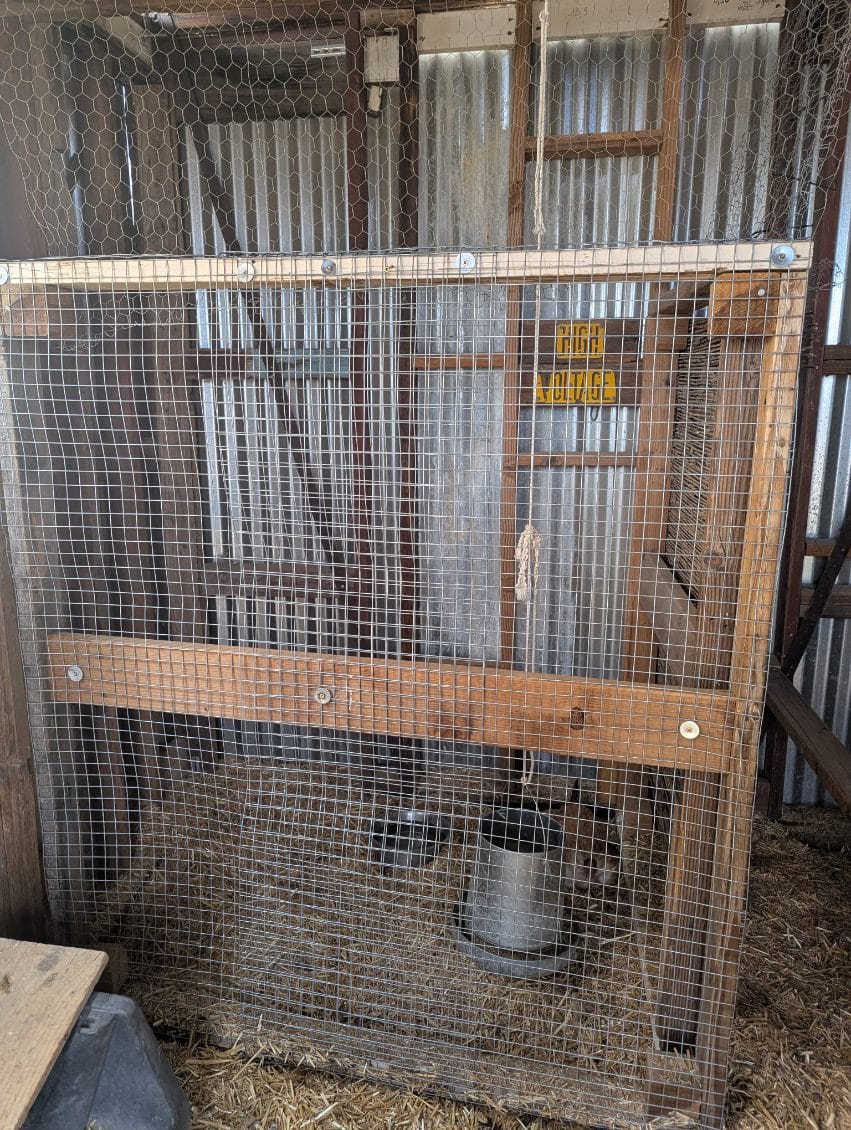
The crucial features of the brood box are as follows:
- The hen can see out the front, but the other three sides are solid. This helps her feel safe, allows fenceline contact with the chicks when they hatch, and ensures she doesn't get confused by eggs being laid next to her (sometimes when we close the box the other hens need to reorient to where they want to nest, since this corner is by far the favorite egg-laying corner, so they may lay eggs outside the other nest boxes near the brood box for the first few days). Sometimes if a broody hen sees another clutch of eggs nearby she'll think she's off her nest and break out to get onto a completely different nest, leaving her partially-incubated eggs to cool and potentially die.
- This seems obvious, but there is a door so that I can access her food and water and clean out poo.
- There is fencing up to the ceiling so that if confused she cannot easily fly over the partition.
- There is enough space for the hen and several chicks once they hatch, up until 4-6 weeks of age when they're likely to be well feathered and able to go out in the run with the flock.
The door in front is fenced and can be lifted off of the hinges fairly easily, and gets stored under a cover near our workshop, and the side partition is fencing covered with reed "privacy fence" from the hardware store to create the privacy a broody hen wants.
This works primarily because we have a large coop and we manage our flock so that we're never stocked to the extent that the birds within that space can't live without those few square feet for a couple of months. We also use moveable nest boxes that sit on the floor, because our flock never took to wall-mounted ones. However, if you have a smaller coop, if size permits, you could create a second level with a special nest box and some extra square footage for movement that can be partitioned off when a hen goes broody. If space does not permit, I could see some potential for creating a desirable nesting site that attaches as a sidecar to your coop or run, which can be attached or simply closed off when you entice a hen to go broody. Finally, if none of these are possible, Damerow makes the suggestion of finding a hard-walled plastic dog carrier of the type you'd take a medium dog to the vet in, and placing it in a desirable nesting site in the appropriate season and filling it with clean bedding and false eggs to trigger a hen to go broody. Once she does so, you could move the carrier out of the coop and into a separate brooding area set up in your barn or elsewhere. However, this does require you have somewhere separate to put the hen, or that the carrier is at least large enough for the hen and her nest, a feeder, a waterer, and ideally a dust bathing site and that you have a plan for what to do with the hen and her chicks once the chicks start moving around more.
Some people put their "teenaged" birds who are feathered out but not yet mature enough to join the flock in a moveable chicken tractor, and I've seen other layouts as well. None of these solve the issue of reintegrating your young birds and hen with your established flock, though, if this is something you plan to do.
Once the hatchlings hatch: things you need to know
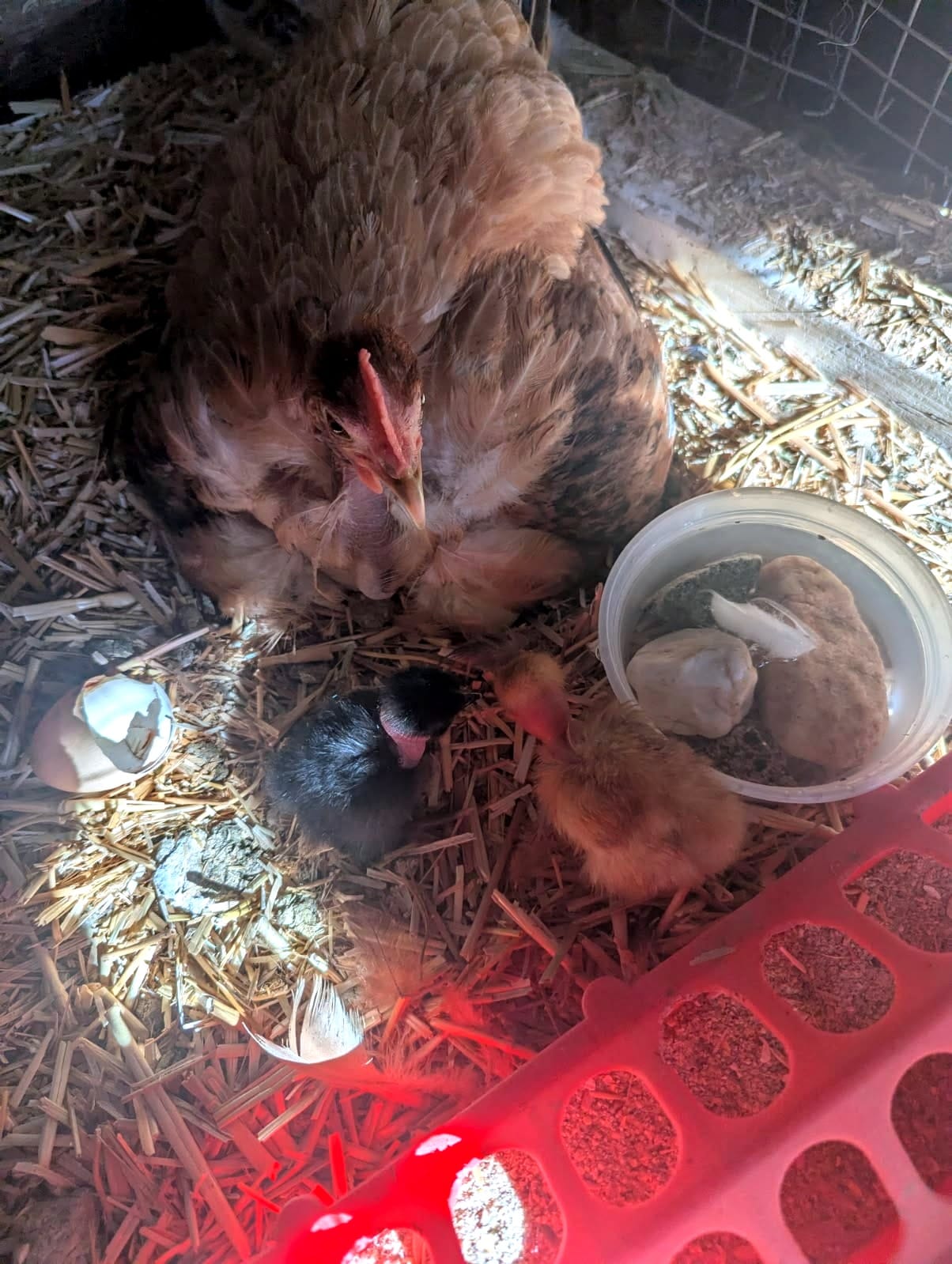
So you've successfully given your hen a safe space to incubate her eggs for three weeks, and now you have fluffy chicks! This is so exciting!
If your hen has gotten this far, and hasn't decided that these fuzzy little beings are intruders, it's quite likely she doesn't need much from you to set them up for success. However, because she doesn't have free reign to seek out a balanced diet herself, nor access clean water herself, she does need you to provide these things. Chicks should be put on a starter ration – usually just called "chick starter" – which has a higher protein makeup to get them off to a good start as they grow quite rapidly, and always need access to clean water. Chick waterers are often a total shitshow in an actual bedded coop – not quite as easy to keep them clean as in a cardboard or paper lined brooder indoors. Our hens consistently kick so much bedding into them that I have to go and clean them every hour or so to ensure the chicks can access water. I tried taking the nipples from our flock's 55-gallon drum waterer and making a miniature version with a 2 gallon bucket, but it took a few weeks for the chicks to be strong enough to depress the nipples themselves. Once they figured it out, though, it was a good alternative. In the meantime, I either just dealt with frequently visiting the coop to clean out the chick waterer or gave them yogurt containers with some stones in them so that the chicks could drink from them but not fall in and drown (shown in the picture) and they'd get dirty but not clogged, so cleaning could be just slightly less frequent. If you have a better solution, please leave it in a comment as this is one area we'd love to optimize!
For the first 4 weeks or so, the chicks should stay in the brood box with their mama. At some point, they may start seeming a little restless. Ours uh.. tend to discover that they can scratch the bedding away from the bottom and go under once they get to a certain size and start feeling confident enough to go a few feet further away from mom. I was initially extremely stressed out about this, but after several attempts failing to re-confine them I let them out of the brood box with their mom and learned just how competent a hen really is at protecting her babes until the flock accepts them. If you think your hens are really sweet and docile, the first time you open that door and let her into the flock with her chicks you'll find out just how wrathful she really can be. The key, though, is that our flock was listening to, smelling, and watching them for the entire prior four weeks, and knew that the hen was still there, and so she was not greeted as an intruder but respected for her existing place in the pecking order.
If your weather is cold, you should plan on keeping the chicks in with the hen for a bit longer, because they need her for warmth. Our weather is never very cold during the day during the season that our hens go broody, in fact it's probably warm enough for the chicks to only be near mom at night, but you do want to avoid chicks getting chilled. Ours can go outside and roam with the flock as soon as they're feathered out so long as mom is still watching them, but yours may need to be supervised a bit longer depending on temps or somehow kept indoors while the flock pecks around out of doors.
Let's talk about feed
Most sources tell you your chicks should be on chick starter until 16 weeks or quite close to when they're ready to lay. This is good, and I certainly think for your first go 'round you should strive for this. However, things get a little complicated when you have pullets in the run outdoors with established layers. The primary concerns for growing chicks are:
- Layer ration has too much calcium for growing chicks, which can cause kidney issues or deformed bones
- Rapid growth requires increased protein, which starter ration provides
So with those being stated, I do think a good rule of thumb especially for beginners or folks whose chickens are only eating the ration they're given is exactly what the sources say: feed chicks chick ration until 16 weeks. This makes a difference in how you set up your infrastructure: offering separate dishes to chickens and expecting them to know which one to eat from is going to be a losing battle. The hens higher in the pecking order will eat what they think is better first, and everyone else (including your chicks) gets stuck with what's left. So if you're this person, it may be wise to plan a large sidecar brooder big enough for your teenaged birds until they're considered pullets about to lay, or use a chicken tractor or other alternative method mentioned above, and plan accordingly for reintegration or rear your broods separately on pasture in tractors if that's more aligned with what your land can support.
But – I'm going to share some caveats here that some of the standard wisdom omits from most of its material. First, the growth of dual purpose heritage breeds with fairly old-school genetics (as in, kept true to type through generations) is not as severe as that of the modern production breeds. This means that while protein is undoubtedly extremely important for growth, and especially in the first few weeks, if your birds have access to insects and pasture it may not be so important that this protein comes from ration. If for some reason it is useful for you to be able to purchase another low-calcium ration and supplement protein another way, so long as you're attentive to your animals and confident that the young birds will truly get enough this is possible. Finally, not all layer rations are created equal and neither are all chick starters. For instance, I thought that the New Country Organics corn-free starter ration we've started all of our chicks on was safe, but it actually has a calcium threshold high above the stated maximum for non-laying chicks. A comparable organic source, Modesto Milling has a much safer standard chick starter with a safer calcium range, but their non-corn non-soy product is also well above the calcium threshold for growing chicks. It appears that when companies switch out the corn and soy for other plant material that provides the other necessary nutrients, or swap in different supplements, the calcium level increases dramatically.
With this said, New Country Organics' pastured perfect layer ration is at the low end of the calcium range for laying hens. When our first round of hen-brooded chicks burst out of the brood box early, we had to find a way to make the feeding situation work well for everyone. I've cut the layer ration with scratch grains about 50% (theoretically dropping the calcium content of the layer ration by about half, though not exactly because there is some calcium in the scratch grains – which isn't listed on the label but is likely 0.01 - 0.05% based on the ingredients in the mix) and begun to offer free choice oyster shell to my hens, which I didn't used to do, so that they can make up the deficit themselves as needed. This also, though, significantly lowers the protein content also, and so all of our birds are currently being supplemented with butcher offal and free ranging more (so their access to protein-rich insects is increased). We must then be more attentive to growth and extremely aware of potential symptoms of calcium toxicity in the chicks. The greatest risks of calcium toxicity in growing chicks are renal failure over time, however, and so the most important monitor is behavioral: we've yet to see the chicks opting to consume the oyster shell, and it appears the hens are taking to the change just fine. They're molting, so consistent feather growth is a good indicator that their diet is not insufficient, especially in protein.
The point here is that so long as we fully understand the needs of our birds, we can approximate a sufficient diet on pasture or with what is at our disposal, but it must be done with great consideration and perhaps not until we've a bit of experience already understanding baseline behavior and growth patterns.
Lessons we've learned: things to prepare for
There are a few mistakes we've made in the past that I think hopefully could inform your endeavors, and so I'm going to include them here while attempting to preserve brevity so that we can wrap up.
First, if you live in a region with high temperatures like us, late May can be dangerous for broody hens and developing eggs. Our first attempt at a brood box was a separate plywood box that had vents and a window covered with hardware cloth, with a small pop door so that when the chicks got bigger we could put up a temporary run next to the flock's run for everyone to get acquainted. However, with the pop door closed and less shade in the garden back then, the box simply got too hot. The hen was okay, albeit heat stressed and very agitated we had to remove her from her eggs, but a heat wave came three days before the anticipated hatch date and all of the developing eggs died. We learned that ventilation is key, and not just a gravity waterer but water the hen can actually stand in to cool herself via the skin on the bottom of her feet. Shade is also critical, and the material you build the box out of matters.
Second, and I've mentioned this briefly earlier, if the hen can see another clutch of eggs nearby she may get confused and think that she's off her eggs. This can be avoided by ensuring the other hens cannot lay where she can see them.
If you attempt to move a hen who is not really broody and shut her in a box, you absolutely will find a disheveled or escaped hen the next morning and most likely some broken eggs. This will also happen (as also was briefly mentioned) if you try to "force" a hen to go broody by locking her in a brood box with a clutch of eggs, or sometimes even if you move a hen at night and she decides the next morning that she is not on the right nest. The risk here is that in her desperation to escape, she could get seriously injure herself. It is important to be considerate of our birds and also thoughtful about building materials. Ensure there are no exposed nails, screws, or other hardware, that the fencing is cut clean and sharp edges are sanded down and that it is adhered to surfaces fully to avoid a hen squeezing through and lacerating herself should one of the above situations arise.
Final thoughts
Not only is it extremely satisfying to see one of our hens teaching her fluffy chicks how to snatch bugs and differentiate real food from random debris, but allowing our hens to follow through on their natural instincts to reproduce is extremely beneficial to their well-being. We also can aid in the preservation of true-type heritage breeds that grow at sustainable rates, live long lives, and are capable of thriving in our environment. Finally, through the provisions of young birds to others who are raising chickens in our communities, we can maintain genetic diversity while slowly reducing reliance on massive hatcheries and their (often) low-welfare or outright inhumane practices.
If you can, I highly encourage you to try to raise your own replacement chicks this next season. If you have any questions, you can always send us an email.
Thank you for reading, until next time ~
Notes
- Different breeds vary, and different kinds of poultry vary as well. I highly recommend Gail Damerow's Guide to Brooding and Hatching Your Own Chicks for a comprehensive table that provides estimates for various waterfowl and chicken breeds, including bantams. In fact, this is an excellent guide to read period! We're providing here mostly the lesson's we've learned, and the modifications we've made to her and others' brood box plans, but all of Damerow's books are invaluable for deeper dives into rearing poultry.
- The group of eggs the hen is sitting on is called a clutch. You'll see me use this term throughout the rest of the article.
- To be honest, some egg farms might just buy stock from hatcheries but that feels inefficient and probably not less expensive than brooding their own chickens, but I guess it's a little more foolproof than trusting nature and would work against the genetics they've already established in their stock. I can't find readily available information on exactly the practices of replacing stock in industrial-scale egg farms, and it's not the point of this article so I haven't spent inordinate amounts of time on it. Just, don't quote me on this one sentence, okay?
- Chickens have no night vision. None. They cannot see in the dark. It's actually really kind of stupid -- they literally will not move when it's dark, even if there's a predator in the coop tearing their flockmates apart. Very much to their detriment, and part of the reason we need to be so diligent in our infrastructure design to keep them safe at night. With this, though, they're awake and eating longer during Spring and Summer, and therefore consuming more calories. When the days shorten, they're late to rise and early to bed, and so they eat less and therefore usually produce less eggs as a consequence, because they're consuming what their body needs to maintain itself but not necessarily enough to confidently reproduce.