On Food Sovereignty
As a person living in a country in the “Global North”, a person who ostensibly has access to grocery store aisles and presumably the income to purchase what is needed off of them, it may seem almost silly, perhaps even performative, to assert that we do not have control over access to food. And yet, we are going to assert this very thing: despite our supposed access to more food-like items than we could ever truly consume, this very supply is a weapon. Food sovereignty, despite what the impression may be, is not solely the struggle of those in the so-called “Global South” for access to food, but rather a struggle we all must undertake in whatever way we can for meaningful control over our food systems as a whole. For I will here make the assertion that you cannot engage a single piece of political action meaningfully if you cannot fulfill your basic survival needs without the very thing that you are acting against.
If you think this sounds absurd, please let me tell you a story.
Friends of mine reside in South Los Angeles, in one of the Latino barrios just North of Watts. One such person, with whom I lived for a time, was raised by a mother who was a first generation Mexican immigrant to Los Angeles. Her family had crossed the border many times, however, before settling in that valley; they often came to work for a season, and then returned. Back then, in the years before the zoot suit riots, there were parts of what we now know as Los Angeles that were still unincorporated. In some cases these areas were relatively rural but in others industrial areas which still stand today (albeit in much different forms, as in the so-called “Arts District” of East downtown). The Western San Gabriel valley, now a cluster of upper-middle class Asian neighborhoods, was yet unpaved: a land of hills and dirt roads, hand-built homes of the working class. Stories passed from family member to family member, friend to friend, and this is what they shared with me:
Back in the days of the pachucos, during the War, and even up through the 60’s in some places, the Mexican settlements were different than now. Still barrios, sure, but there was a culture of cultivation: mamas kept their chickens, their gardens; lots of families had a goat or two, a pig. It was still common to cook what grew or was raised in one’s backyard. There was still poverty, but where staple foods could be kept close to hand, I’ve been told hunger was diminished, and things could be traded among neighbors when times were hard for any one of them. There was a semblance of food sovereignty: things that did not need to be purchased could be traded or engaged in commerce with agency. Se decidieron. They decided.
But, as the history has been told to me, this frustrated both those who wished to employ Mexicans as well as the city as it sought to expand and offer housing to more affluent white residents in these yet-uncrowded areas. The capability for someone recently unemployed or chronically underpaid to fall back on a community of support or their own backyard “farm” was a kind of bargaining power that felt threatening to those who desired to make Los Angeles, well, what it has since become. Measures began to be passed, as the roads were paved over and the demographics of their barrios changed: always subtle, never the kind of thing that made newspapers, but restrictions similar to those that can be found here in the table stating what size lot is required to keep “livestock as pets” (in other words, to keep livestock on the property). While it might seem reasonable to say that in order to keep livestock at all you must live on a 15,000 square foot lot, and that the animal pen must be at least 35 feet from the house, consider that the average lot size in the City of Los Angeles is aproximately 6,500 square feet[1] for residential lots containing a single family residence (the average is smaller for multi-family residences such as apartment buildings). Other examples include the myriad of specific noise ordinances, public health measures, and so on that claim to be “aiding in the retention of property value” and “protecting public health”.
Thus, the slow death of food sovereignty in the Latino neighborhoods of Los Angeles came about rather quietly, with beauracracy and the discriminatory enforcement of the new codes and many other rules of “law” slamming nails in the coffin door of cultural independence.
Los Angeles was not unique in this: Detroit, it’s said, was once a hotspot for urban gardens. The city’s Black residents supported one another much like the Mexicans and Chicanos of Los Angeles in the early-mid-20th century, until Hoover-era reform put it on a path to becoming a food desert, as it has been for much of the last four decades.
While there is a resurgence in urban gardening initiatives in places like South Central Los Angeles, West Oakland, Detroit, and Chicago; and while in some areas there has been some loosening of code restrictions and other regulations that previously made gardening illegal or at least ordained against, generally speaking it is not common for most Americans to truly control their food sources. Even many urban gardening initiatives (though not all) rely on the purchase of compost, soil, fertilizers, or manure from elsewhere, and many are still prohibited from raising animals where space isn’t already a primary prohibiting factor.
But of course, if you reading this are still quite assured that you are food secure, it is likely that you may take the lens that this is still an article about the struggles of people quite unlike you. However, there is the great possibility that while these regulations and rules sought to destroy the last vestiges of food sovereignty in the great urban-industrial centers of the country during the expansion of the suburb and the white middle class at the end of WWII, those self-same members of the white middle class were also giving up their sovereignty as they left the country and moved to the new outskirts of happening cities, with emerald lawns and swimming pools, much to the delight of the corporations that sought to fill the needs and desires of folks who until relatively recently had fulfilled many of their own.
This is only part of the story, because, you see, in the center of the country just a decade or so before the infamous zoot-suit riots, where racial tensions in South Los Angeles came to a head (one occurrence of many yet to come), there was the publicly quiet but violent takeover of most of the remaining family farms throughout the wheat belt of the United States. During the Great Depression, when farmers were taking out mortgages on previously fully owned land to survive the drought years leading up to the Dust Bowl, the rise of new technology brought to us by dear John Deere led banks to come collect when the drought continued and farmers couldn't pay their loans: taking ownership of thousands of farms and combining them into enormous corporation-owned megafarms which could now be operated by a handful of workers (or even a single one) on the back of tractors rather than thousands of separate family owner-operators. The rendered obsolescence of the family farm sent families who in some cases had worked their land for generations off, often violently and under the threat of starvation in the light of the collapse of their soil. These now unemployed and hungry people were then coerced West, where the owners of orchards and plantations in California had conspired to drive down labor costs by flooding the Dust Bowl states with flyers claiming that there were more jobs to be had in California than people to fill them. This of course was untrue, and when most of these emigrants arrived in California they found not empty farms needing for workers but tent encampments everywhere full of starving people looking for work, or being paid pennies for backbreaking labor because there was less work than there were laborers, and little bargaining power for better wages.
Who, then, do you think flooded California to fill the factories and farms in and around Los Angeles and the Central Valley, competing now with the Mexicans who, in some cases, had resided there since before the United States annexed California for their own (and who until recently had more bargaining power, homes, and their own sources of food)? And who populated the new suburbs installed in the San Gabriel Valley as Latinos were pushed out, little by little? Well, it may not have been the emigrant “okies” who found themselves homes in the suburbs, but many opportunistic middle and upper middle class Angelenos fleeing the undesirable waves of immigrants into the city, as well as a newer wave of more affluent immigrants, and those with wealth from more rural regions looking for opportunity near the growing city. As populations rippled past one another in movements into and out of the inner city, this era saw the creation of new neighborhoods that even today split socioeconomic status dramatically along a major intersection or a set of railroad tracks.
This is a true story, and yet perhaps we should read it as a parable. The moral of the story is that there is no potential for the coercion of a labor force or a political body without the need for food, shelter, or medical care – a need which has been manufactured for us in lands that once held untold abundance. This has been proven since Europeans first began their war against the Indigenous peoples of South, Central, and North “America” – and before, on other continents, where the goals of empire relied on expansion and the subjugation of a land’s existing residents. The mass slaughter of bison in the now-US, for instance, was not done out of ecological ignorance, but rather with the murderous goal of starving out and forcing the movement of peoples who were known to rely on the bison as a primary food source, peoples who were known to follow the herds and manage the grasslands. The second and third-order impacts of the destruction of North America’s largest herbivore weren’t accidental as the Park’s Service and conservation organizations will have you believe: the goal was the collapse of the ecosystems the Indigenous peoples relied on, not just the populations of bison (though that would have been bad enough).
It is unfortunately out of the scope of this article to discuss the very real fact that the food supply we have access to as a result of the now-established industrial agricultural system is most likely poisoning us, but this is certainly one way in which the illusion of food security is killing us. It is also out of scope to discuss how this same system is still destroying entire ecosystems, leaving even those who still have the knowledge of food cultivation reliant on it, though these are both critical aspects of this conversation.
Instead today’s discussion can really only focus on the urgent reality that if you wish to act against a regime, you cannot do so where your basic needs cannot be met without that regime. If you are someone who takes to the streets and protests, I urge you to deeply consider these words. The very act of organized protest asserts first and foremost that your needs (or those of whoever you purport to speak for in that moment) are not being heard, and yet protest is often organized before communities of support[2] in the vein hope that the regime itself will suddenly have a change of heart if it and its other citizens are inconvenienced enough. There are ways to put pressure on a regime, but the only way revolution truly works is if those engaged in it also control the production of the things they need to survive. This is why, historically, under the structure of the institution those of us in much of the “Global North” live under, but particularly in the United States, revolutionary movements are met first with violent repression, then a kind of illusory and apologetic acceptance, and then a transformation into product. That there exist Che Guevara t-shirts and Bob Marley hats and all kinds of quasi-”hippie” products indicate that ultimately where regime can transform revolution into a product that serves its economic ends all the while placating the feelings of those who would otherwise revolt rather than consume, revolt has no chance. Not only are you ultimately at the mercy of the institution to not block your food supply, poison it, or incarcerate you and deny you access to it, but you are ultimately powerless against the structure of the institution itself. You will continue to go to work, because otherwise you would go hungry and houseless, and so while you might take a Friday off once in a while to put on a mask and go march, it is known that you cannot or will not do much more than that. This cycle of repression and then co-option only works if the citizens have no other option but to accept the commodification of their dissent rather than its desired results.
Therefore, the goals of food sovereignty are the goals of liberation. That we have been criticized for spending “too much time” setting up systems of cultivation and not enough time on outreach or protests indicates that there is a glaring misunderstanding of what conditions need to be met for a citizen of any nation to truly have bargaining power, or the potential for changing the conditions of their life more generally.
That this is all also tied in to the death of our ecosystems and our bodies is not coincidental: ultimately there is a first step towards the rectification of all of these wrongs, and these wrongs are not just collateral damage, but part and parcel of the entire agenda of authoritarianism. That not every actor in the great history of the eroding of our ability to access land and cultivate our own networks of trade has been “in on” some great conspiracy doesn’t make the erosion any less intentional, and I think we would do well to examine the incentive structures that underly the conditions of our lives moreso than reacting solely to the conditions ourselves, for one cannot be changed without altering the other.
Towards Food Sovereignty
There are complicated reasons why not everyone is necessarily aiming towards food sovereignty, not least of which is, of course, that perhaps they haven’t thought it very important. Moreso, though, among peoples for whom it is recognized that this is a crucial action, there are very legitimate barriers to achieving food sovereignty. First, to cultivate food requires access to land, and land in most countries globally is now enclosed, or in other words, privvy to private property laws. How these laws impact the cost of land, the financing of land, and what you can do with the land once you own it is extremely variable worldwide, but it is not always straightforward to just “buy land and farm”. In all of Southern California, for instance, for almost every zoning code (even RC or "resource conservation"), you must build a single family residence before building anything else: even a pond, though it isn’t a building. You are forced then to build on vacant land. You are, in almost every case, not allowed to even camp on the land that you own without restrictions about how many days a year you can camp there. This means I could not just buy vacant land, farm it, and live in a tipi. Whether I paid cash for the land or not, this would be illegal.
This doesn’t even take into account the affordability of land in various places: vacant land is usually a cash deal, which means you have to have some liquid income or the ability to have a savings in order to purchase it, and will-carry or owner-finance situations can get dicey. Purchasing a pre-built home requires, in most cases, a mortgage, and then you don’t really own the land until you pay it off, which in a lot of cases the bank knows that you never will[3]. Now, that doesn’t mean you can’t do anything with the land, but it does mean you have to maintain a source of income until the mortgage is paid off or you lose it.
Despite these very real barriers, however, it is not impossible. There are various ways to cultivate food sovereignty that don’t require owning land at all: if you live in an area adjacent to wilderness, you could sneakily (and with great care to maintain the balance of the ecosystem you live in) cultivate edible natives in wilderness and periodically forage. Hunting tags are cheap in many places in the US, and with a deer or two you could feed a few people for a winter or so. Ditto for fishing tags[5]. If you live in an urban area, guerilla gardening a vacant lot is an option (though one that requires collaboration with neighbors and an awareness of what the consequences might be if you’re caught), as is collaborating with others to garden a shared courtyard, petitioning an HOA to designate a small space for a garden, and so on[4]. Better yet, if we must work within the economic restrictions at play, we should do well to create networks that enable us to pool resources and hold land in a trust or other entity that will allow us to share resources to bring the land under cultivation and designate segments of it for rewilding. This latter option, while less accessible for many, is beneficial because if done strategically it is the most likely to allow for the long-term cultivation of the land without legal intervention. Laws can always change, and the government (at least in the United States) could always come and claim eminent domain or charge you for some other crime and "confiscate" your land. This is a risk we must take, but we don't need to take it blindly. No one engaged in cultivation need be connected to action that could bring the wrong kind of attention to the land, and allowing for engagement with the restrictions placed on us by the economic and political system could be a way to allow for sustainable food cultivation while mitigating the risks of losing that land. However, it is worthwhile to set up systems following the other suggestions in the meantime while resources are pooled or if the money for such an endeavor is unlikely to ever be found. Something is better than nothing, and the more people who are invested in the work of food cultivation outside of the existing industrial system the better, for we can create reliance through redundancy and the decentralization of such efforts.
The crucial thing is that this endeavor cannot be undertaken alone: historically, even in village settlements after the rise of pastoral agriculture, there was relative specialization by people who then had a network of people with whom to trade. True self-sufficiency is, by and large, a myth. Even those who live in the Alaskan bush and see humans only once or twice a year and trap or hunt or forage all of their own food rely on the trade of goods through towns for things like shoes and clothing, household supplies, skills or tools they don’t have themselves (I.e: perhaps they take their skins to a tannery, their wood to a mill that has a proper planer, etc.). So while we should all do well to start cultivating what it is we can, in the most sustainable way possible, as soon as possible, it is also vital to begin coordinating our efforts with others to ensure that we are setting up networks of aid, skillshares, and filling the gaps in one another’s environments with things that ours produces better.
Now, I say all of this at the risk of sounding like a broken record. I know that I’ve said similar things before as they’ve been relevant to different topics. However, rather than being a failure in our ability to write good information, this theme is recurring intentionally and because it truly is so central to not only our efforts here at Rancho de la Libertad, but ultimately to each and every aspect of the liberation of human life. Food and water are central: even housing can more easily be arranged and shared than those.
Truly bringing land under cultivation in a sustainable way takes years of establishing critical infrastructure, building soil, understanding the ecosystem we’re working with, and understanding which species will benefit us and the ecosystem the most with the least amount of labor and inputs required. As the proverbial water surrounding us in this pot of our civilizations comes closer and closer to a boil, let this be a call to action: spend some time in between your other efforts figuring out how to work with the earth, offer your skills to others, and cultivate networks of mutual aid that do not rely on empire to function. If the time to start such work was yesterday, or last year, or even ten years ago, then there is no better time to start than today.
Thank you for reading. I look forward to delving deeper into some of these topics another time, but was hoping to release a relatively brief post this month that is hopefully nevertheless impactful. On the topic of this article: if you or someone you know is engaged in the work of food production or has other skills they wish to share with such a network of trade, feel free to reach out to us via email as we are always looking to make such connections both in the region in which we live and elsewhere.
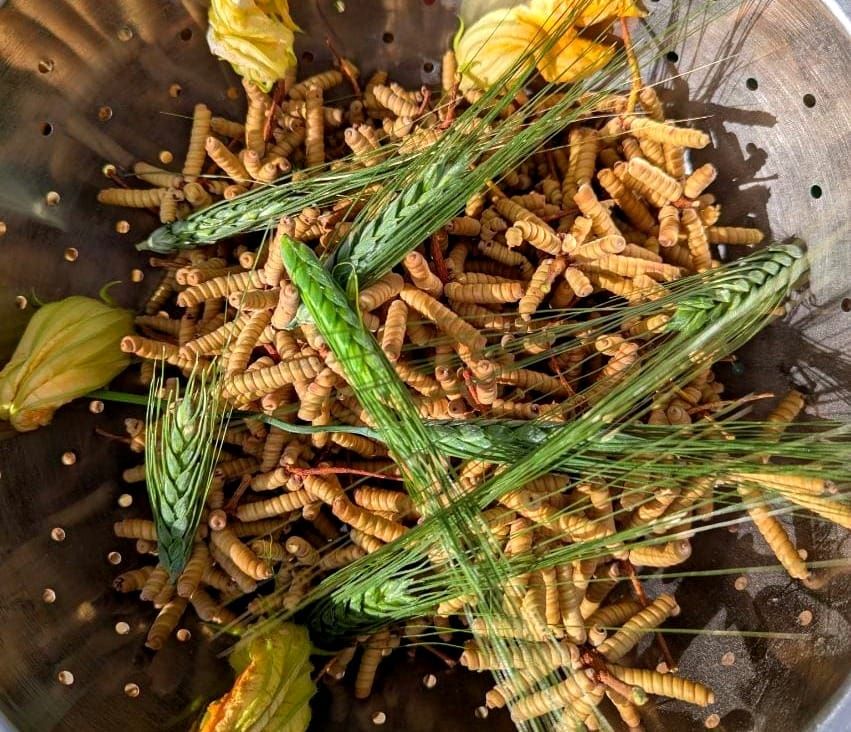
This month's paid newsletter will be an original recipe honoring an ingredient we just harvested here at the Ranch, and in our opinion it's worth paying for access to. Paid subscribers help us keep this project going, enabling us to feed others and ourselves and build resilience and sovereignty in our ecosystem. If you are already paying to access all of the knowledge we share, or if you take the time to share this newsletter with others, we thank you! You are a critical part of our mission and network.
Until next time ~
Notes:
- Source
- Stated with the understanding that of course in some instances activist groups are setting up mutual aid networks simultaneous to organizing public political action. However, in my experience at least these aid networks tend to focus on the collection and distribution of money, legal aid, and sometimes things like clothes and food. There are precious few networks that are set up with cultivation at bottom, and where food is a tenet of the mutual aid network it is almost always purchased and then donated. It would make more sense, to me, to first pool funds to purchase land, purchase the land under a trust or other legal entity so members may be added or removed when needed, pool labor and resources to get the land under cultivation and perhaps provide housing as well, and then utilize the resources that are now being created continuously to support those who are actually doing the political action.
- Think of a 30-year mortgage term where you actually end up selling the house after 10 years and purchasing a more expensive house with the cash equity you got from the first house. You’ll keep getting nicer and nicer houses this way, and lots of people do this, but generally the housing market trends upwards in terms of price, so you’ll never really get your money’s worth out of the homes you’re selling as you’re almost always going to be buying back in at a higher price. Banks know that most people don’t stay in a home for 30 years anymore, and count on status aspiration to keep them aiming to buy more and more expensive homes, never paying them off as they go. You’d need to either buy back into a depressed market or go from a nicer house to a less nice house (or one in a less desirable area) to actually use the equity from the first house to pay off the new one: this happens when someone from a high COL area like California goes and buys into a market in Tennessee or somewhere else less expensive, but then there are obviously ramifications for that housing market and that culture when this happens frequently. The point though is just that most people don’t ever actually pay off a mortgage, and that’s potentially a word of caution for if you take any of the advice in this article and go look for somewhere to start cultivating food.
- Apartment gardening on a balcony or in pots is also an option, though I’d argue that as soon as you’re relying on someone else’s soil, compost, pots, and so on the “sovereignty” part of this goes away and you’re just gardening to supplement the grocery bill a bit, which is certainly not a negative but doesn’t fit well into the scope of this article.
- Understand, though, that most fishing that is legal in the United States is from water sources that are stocked with farmed fish that are the product of intensive industrial cultivation. Fishing is a sustainable source of sovereignty in a few regions where wild rivers and natural lakes are still present, but not everywhere.