On Pigs and Integrating New Allies
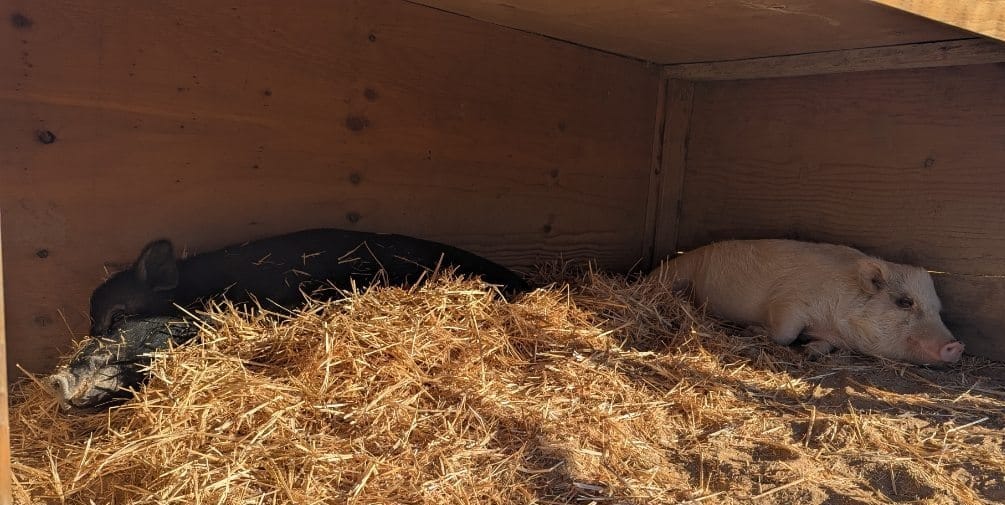
If you keep up on our Quarterly Updates, you know that we recently brought home two adult potbelly pigs from a homestead that needed to offload most of their animals. Quite a few people since have reached out and asked questions about these new allies, and I'm very excited to go in-depth about how we plan on integrating these and future pigs into the system here at Rancho de la Libertad.
Why pigs?
Everyone loves goats. Loves them. I don't blame them, goats are great. Most of the holistic management and small regenerative agriculture folks recommend goats, chickens, and sheep for rotational grazing and grassland restoration (cattle also, where land permits), and lots of new homesteaders or permaculture folks follow along with this knowledge and get goats or sheep after they're comfortable with their chickens, which are almost always everyone's intro livestock.
If you live somewhere with lots of rain, where your biggest issues are invasive vines and thorny brambles, goats are an excellent choice for an integrated system. They'll save you lots of labor and convert all of the unwanted vegetation into meat and milk.
However, if you live somewhere that's already been overgrazed by cattle, sheep, and goats, and where soil compaction is a primary issue, an animal that will consume the remaining mother plants and compact soil with its hooves is probably not your best bet, depending on your goals. And yet, here in the Mojave and in parts of the Sonoran and the Chihuahuan, where we've met lots of permaculturists and homesteaders, goats are still the first choice of those looking to introduce bigger livestock than chickens.
But pigs are so overlooked in these environments! Pigs solve our primary issues rather than compound them. As monogastric omnivores they're more likely to convert our household food waste to meat than fibrous green plants – of which relatively few are usually present on our land before intensive cultivation. Additionally, while their rooting instincts make them a difficult management issue for those with soft, grassy pasture, they're perfect for those of us with hardpan soil and lots of rocks to move.
Integrating pigs into the whole
Our choice to get cast-off pigs at first was an intentional one. We've had plans to purchase well-bred heritage hogs from Sage Mountain Farm (a local ranch based in Anza, California that currently supplies all of our meat with their own heritage and pasture-raised fare) for at least a year now, but it's important to us to ensure that we optimize our systems and can ensure good management practices before investing significant resources. When we found out that the homestead in the low desert was offloading their animals, we knew we had to bring the pigs home. They needed a better environment, and we're happy to facilitate this in exchange for the opportunity to learn with slightly lower stakes (our management can't really be worse than their previous situation, so they're quite happy with this arrangement).
As these hogs are adults already, we won't be training them on electric fencing for intensive ranging. These pigs will be penned for the duration of their stay with us, as we learn their behaviors, feeding habits, and how to be the best pig caretakers we can be. We've learned through trial and error that introducing additional complexity without fully understanding any aspect of our system leads to, well, complications, and we're learning to take things one step at a time and iterate on infrastructure once we learn through experience (books are excellent for getting started, but experience is a better teacher: ultimately none of the books are written for our environment and we often have to break convention to make things work well).
Pigs are not goats, but what are they? Yes they eat lots of things (well, as it turns out, these pigs don't, more on that in a minute), but what else do they do?
Each time we consider adding an element to our system, we consider what the system can offer that element and what that element in turn offers the whole system. Our breakdown includes lists of what the animals need, and what we need, and what the system as a whole needs. It's a little like this:
Our needs (what isn't being fulfilled right now)
- Additional meat source: chickens alone are not filling the human-nutrition niche, and we can't raise enough of them for them to make up a substantial portion of our protein needs given the infrastructure we have[1]
- Reduction in food costs: for us, and for our other omnivorous ally, our dog (his food totals about $75 per week, as he eats whole foods and sustainably raised meat, not kibble)
Land needs
- Decompaction of soil: many seedlings in newly-created basins and future pasture areas won't get past two or so weeks after germination because of compacted soil and an inability to grow root systems that support above-soil growth
- Organic matter and fertilizer (manures and such): our soil lacks organic matter and critical nutrients including nitrogen, phosphorus, potassium and is primarily silica (sand) so water is not efficiently utilized
- Chickens fill this niche as well, but there are benefits to diversifying manures available, as in an unmanaged ecosystem, and there is a limit (though sometimes it doesn't seem like it) to the manure 22 chickens can produce
Pig needs
- Water for drinking and wallowing (clean water and wallow/playing water)
- Food: lots of carbohydrates, enough protein for relatively rapid growth and body maintenance, dietary fiber
- Space: not as much as ruminants, but enough to move around sufficiently and rut and root without having to live in mud constantly, enough space to create a "bathroom" where excrement is deposited away from the sleeping/loafing area
- Ground to root: part of space, but specifically ground that encourages or enables rooting
- Housing: something to keep them out of harsh winds and rains
- Company: pigs are extremely social creatures and cannot be raised alone. Space, feed, etc. all need to take this into consideration.
There are other questions that go along with this, such as:
- What other options do we have for fulfilling system needs? and are any of these options more sustainable or do any of these options fulfill additional system needs?
- What aspects of the system as it is now can supply the pig's needs? What external inputs will be relied on if we introduce them, and how can we rectify that? Are there any external inputs that we will never be able to live without if we introduce this element?
Generally, all things must supply more than two system needs to be considered for introduction into the system, especially if external inputs will be relied on. For now, for instance, all of our animals are on straw bedding. Straw is an external input, and one that we don't particularly like because of how it is likely cultivated. Eventually we can get away from this by producing enough green waste (like grasses that act as cover in off growing seasons in specific parts of the garden where annuals are grown primarily), but we've decided that although we cannot supply this need from within our system yet the tradeoff of being able to supply food is greater than the detriment of needing to have straw. Our animals also all receive organic commercial feed, as our land is not yet productive enough to produce all of their food in all seasons, though the goal is obviously to close that cycle and produce all of our nutrients through the entire food web on the land.
For pigs specifically, at least for our soon-to-come heritage hogs, we will be able to supply a significant percentage of their caloric needs by this upcoming Fall from our own gardens. We have been cultivating for some time an entire garden area specifically for animal feed, and lots of those crops will come to maturity in the fall and then ready the soil for the next season's crops. Our newcomers are potbelly pigs (sometimes called Vietnamese potbelly pigs, though this is somewhat misleading as there is another pig actually native to Vietnam called the I pig that these are late descendents of but which these bear little genetic resemblance to at this point) who have been raised their entire lives on pellet feed, and they eat very little supplemental food. I've convinced them to eat apples, pears, and dates – they love dates, but these are treats, not meals. They will eat the occasional squash but won't eat anything green, so they're hardly our dreamt of food recyclers. We know, though, that the stock we're purchasing from Sage Mountain will be much more efficient at converting greywater-grown vegetables, grains, and grubs to meat, as Sage raises their pigs on organic vegetables and pasture forage almost entirely.
This makes pigs extremely desirable: while pasture is much more difficult to cultivate in our environment, especially given how resource-intensive it is to grow trees for shade, vegetables and some grains are fairly easy to grow in abundance with greywater. The trees that we have planted for shade needed to be prioritized around the dwelling, first, and only after we've established this "nucleus" of green space can we start extending our growing efforts out to the future pasture. Pigs, unlike goats or sheep, can be a part of that nucleus and don't require so much forage space that they will inevitably need to be grazed outside of it. They can spend much of their time in a dry pen, and then spend harvest season hogging down[2] the greywater basins, rotate to some compacted, rocky areas to turn over the soil for future planting while being fed cut-and-carry veggies and household wastes, and then return to the dry pen happily to continue getting cut-and-carry foods and wastes. We do purchase some bermuda hay for them currently, but fibrous common hay grasses like timothy and bermuda sprout from the straw we bed and mulch with, and so this can probably be eliminated in the next few months as well.
Deconstructing Myths About Hogs
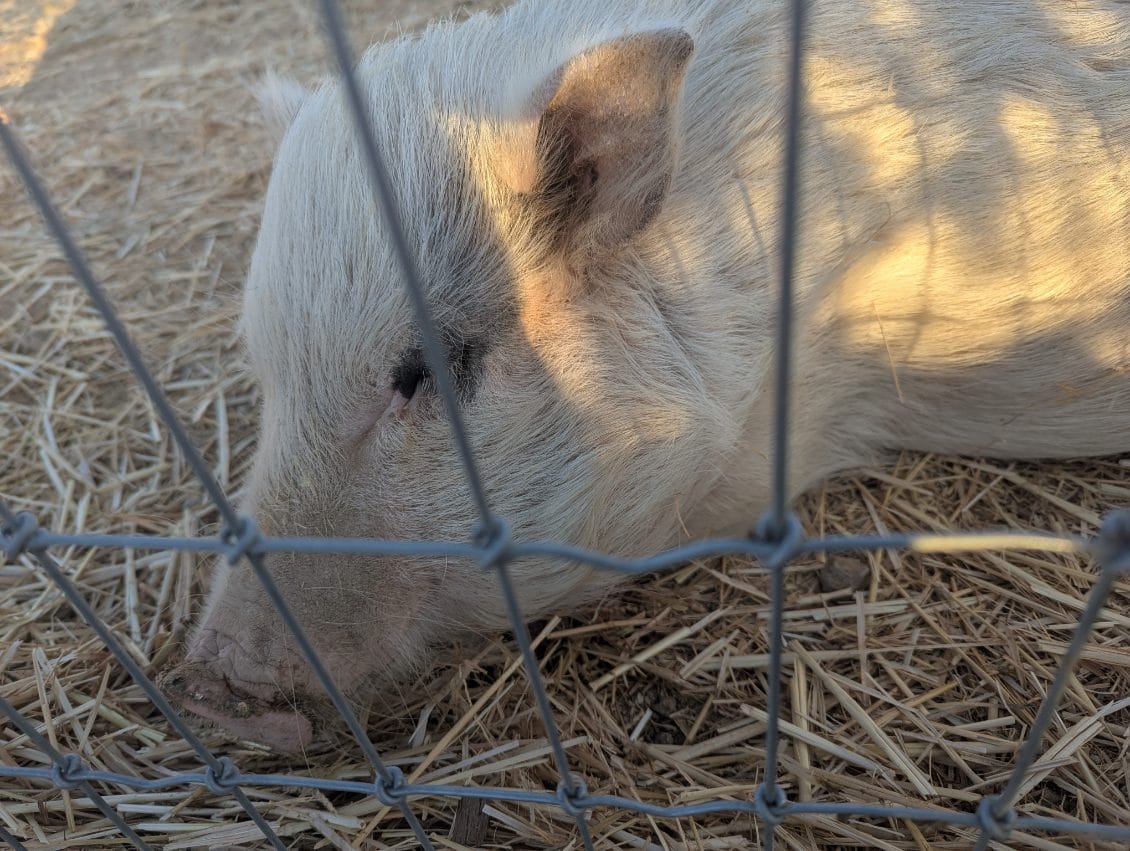
Few animals are as maligned as the pig, in my opinion. Their reputation is that they're dirty, stinky, and unhealthy to consume. Why not opt for lower fat meat sources and keep the farm smelling better?
Much of the misinformation around raising pigs and eating pork is intrinsically tied to class conflict. Pigs have always been the common person's animal: peasants could keep a hog in a small pen behind their dwelling, and it could transform cooking waste, garden scraps and even human excrement into valuable protein for a family. In rural China, outhouses were built above pig pens and the pigs were fed on this and household food scraps. But pigs need not convert sewage if we find that difficult to stomach[3]: they are valuable consumers of roots and squashes from the household garden that are unfit to store through winter, the leftover grains missed in the field after harvest, acorns and seeds from trees as well as plentiful grubs, insects, and rodents as they forage through woodland. While the lords of the manor kept cattle on their extensive clear-cut acreage, the peasants kept pigs and benefited from a sustainable, cheap source of life-saving protein and fat for fuel and cooking through the winter.
Pigs are considered filthy, but unlike chickens and rabbits, they refuse to sit or scratch about in their own waste. Ours have chosen a corner of their area to use as a latrine, and we bed it deeply with straw and clean it out once a week, using it for compost. They refuse to lay in or hang around that corner, and only go there to use the bathroom. Animals tend to like to be clean, it's only when we don't give them enough space (or when our management strategy doesn't involve periodic cleaning) to engage in their typical behaviors and they're forced to live in their own excrement that they do so.
Finally, is pork unhealthy? As it turns out, like most things, factory farmed pork is pretty awful. This is due to not only the breeding for excessive growth and a very bland diet of nearly all corn, soybeans, and mineral supplements. It is also due to the fact that unlike even feed lot cows industrially farmed pigs literally do not touch dirt, ever. They're bred for size, not disease resistance, and they never see the sun. How do we think that manifests in terms of their body composition, when they don't have access to dirt, sunlight, non-chlorinated water, or the ability to move their bodies in terms of their ability to synthesize nutrients and produce the kind of body they're supposed to be able to produce? If a human lived in those conditions, they would be weak, atrophied, anemic, and chronically stressed, at minimum.
While more research is needed more generally on the difference in nutrition between pasture-raised and industrially produced pork, generally the research available shows what is intuitive to anyone who has ever tasted the difference between the two: pasture-raised pork is healthier, has better ratios of beneficial fatty acids as opposed to inflammatory ones, and has better vitamin and other micronutrient profiles[4][5]. The boom in consciousness about the poor health (human and cow) that results from grain-fed and industrially raised cattle led to an enormous amount of research done on the nutrition profiles of conventional vs. grass-fed beef, but pasture-raised pork has gotten less attention, and part of this (and a result of it as well) is that there are less producers of pastured pork out there for studies to be done on that can be considered statistically significant. Additionally, there are no real standards for "pasture-raised" labels, and "free-range" labels just mean that the animals were given access to the outdoors, without any stipulations about how much access or how much time they were able to spend outdoors (it also doesn't tell you whether they were in dirt and grass or on concrete).
So, "is pork healthy?" is a bit of a nuanced question. It depends, where is your pork coming from? Conventional pork is something we can all live without – there are just too many better options for protein. But pastured pork, and especially pork raised in your own community on foodstuff that benefits the land and the animal (and you afterwards)? That's a different story. And yes, pork is definitely fattier than beef, lamb, chicken, or rabbit. However, the way we orient to diet (and what studies are increasingly showing) is that fat is not the enemy. Fat is actually incredibly important, and from a nutritional standpoint that considers nutrient needs rather than nutrient excess, it's important to produce sources of fat as well as sources of lean protein and other nutrients. As a moderate part of any relatively sane diet, and when consumed in awareness of one's own bodily needs and habits, pork is certainly a fine addition. We tend to eat more pork in the winter, especially fatty roasts, hams, and bacon. The extra fat helps us maintain energy levels and replace energy lost to keeping our bodies warm. However, we're extremely active all year, and so we're not concerned about a minor surplus of any given macronutrient during one season, as it all balances out during other parts of the year when we tend to eat leaner protein sources and more plant-dominated meals.
Speaking of fat: lard
Lard deserves an honorable mention. For our ancestors, fat was scarce, and any fat for fuel or cooking would have been incredibly valuable. While we live in a society and an era of abundant fats from all kinds of sources (including chemically extruded vegetable oils, which shouldn't exist and which we refuse to consume), fat is still one of the biggest costs in our kitchen. A gallon of olive oil costs over $80 and that's if we buy it in bulk. Avocado oil isn't much less at about $60/gal. We stopped purchasing butter altogether, as it's just prohibitively expensive and difficult to find a decently ethical source for.
But lard is an incredible resource. We use it for cooking and baking, but it can also be used for lamp fuel, candle making, even skin care (beef tallow skin products are kind of all the rage right now, but lard is the same thing, just from a pig).
Not only is lard useful, but it's sustainable. Here is this incredible being that lives in our pasture and eats our leftovers, and it not only produces upwards of 150 pounds of edible meat, but a dozen or two dozen pounds of valuable fat, all at once. No dairying required, no cartel-run avocado trade, no extensive olive farming and expensive processing required. And yet, lard is another product that has been the victim of class conflict: who eats lard? Well, here in California they certainly don't sell it at Sprouts, but they do sell it at Superior and Cardenas (Mexican grocery stores). In middle America you'll find vegetable shortening – industrial ag's poor replacement for lard from the family pig – in the houses of most rural low-income families and probably only see lard at the funnel cake stand at the county fair. I wonder why we've vilified this cheap source of nutritious and versatile fat? Perhaps you can guess.
Final Thoughts
All in all, we're incredibly grateful to these beings for joining us here on our land, and we're glad to see them run about and thrive. We are spending every day with them honoring the sacrifice they'll make for the other beings here, and that of further generations of heritage hogs after them. They're providing more to the land and system as a whole than almost any other component: their rooting, their recycling of waste nutrients into valuable food for us and others, their valuable fat, their hides.
Raising pigs gives us the opportunity to carry on the efforts of other farmers and land stewards: breeding for good foraging instincts, sustainable grow-out, good health, and friendly temperaments. It also enables us to bring more soil under cultivation, which in turn enables earthworks that let us counteract the hydrophobic nature of our soils, reverse soil collapse, grow insects, native plants, native herbivores, and feed our community good food. We all have many jobs to do here, and the pigs do theirs with joy, some snorts, and lots of other antics[6].
So thank you, pigs. And thank you for reading!
Notes
- Technically the lift to build pig infrastructure wasn't necessarily greater than the lift to build out meat-chicken infrastructure, but we didn't want to over-index on chickens for two reasons:
a. First, chickens fill one specific ecological niche. They eat certain things, of which our current system can provide a certain amount, and their supplemental feed is expensive compared to some other species. It's hardly more sustainable to pack our land full of chickens than to diversify our animal species and more closely mimic an unmanaged ecosystem.
b. Second, we raise chickens primarily for eggs and their beneficial instinctive behaviors. Meat from excess roosters and cull birds is a kind of side benefit, but the chickens we raise, while being dual purpose, don't produce that much meat per bird compared to the amount of feed they consume to get to the size they need to be to eat them. We also don't ethically agree with raising "broilers" that are usually hybrids that are unable to walk or survive past the date they're meant to be slaughtered. - "Hogging down" is the practice of growing a crop (either specifically for animal feed or not) and then allowing hogs to "harvest" part or all of it and in exchange disturb and fertilize the soil for the next planting. This is useful when running pigs like kune kunes through green manure crops, or when allowing heritage hogs to glean nutrients from portions of plants inedible to humans (i.e: corn stalks). In our example, we're growing ground-growing vegetables (squash, pumpkins) in greywater, as well as lots of roots (turnips, radishes) that the hogs can till up with their snouts and harvest themselves. We can save money on supplemental feed this way and give the pigs something beneficial to do, they will in turn decompact and fertilize the soil in our wastewater basins and prepare it for us to plant things that we want to eat (and perhaps more tubers that can be pulled and brought to the pigs).
- If you've ever been really, truly hungry I'm sure you can sit with it just fine, most opportunistic omnivores will eat poo if given the chance. Your dog does this, too, if you'd let him, or when you aren't looking. When killing prey, carnivores and omnivores alike will eat the intestines first for the already partially digested calories present there. While I would certainly not feed my hogs out on human excrement, as I think better quality meat can be obtained with more diverse foodstuffs, I would also not go to a more impoverished part of the world and judge anyone without access to commercial TMRs for doing so as a supplement, not as a sole feed.
- Study showing preliminary results of 50% increase in Omega 3's rotating pigs on pasture with a variety of diets (not just "grass fed")
- Fact sheet from Hampshire College explaining this concept slightly further
- I do want to, in the near future, write a post about dealing with hog behaviors that may not be so desirable, including aggression, females in estrus, and training. I'm learning a lot about safe engagement with these large and occasionally dangerous animals, but I'd like to have more experience to share before getting into to much detail.